

Key Service Dog Training Requirements to Know
- Advertisement -
When training a service dog, you need to understand and fulfill specific requirements and standards to guarantee your canine partner can effectively and safely assist you in daily life. The International Association of Assistance Dog Partnerships recommends a minimum of 120 hours of training, with at least 30 hours focused on training in public. You'll need to pass the Public Access Certification Test, which evaluates your team's performance in public spaces. Additionally, your dog must master basic obedience skills and perform specific tasks to help with your disability. By meeting these requirements, you'll be well on your way to having a certified service dog that can accompany you anywhere.
Key Takeaways
- Service dogs require a minimum of 120 hours of training, including 30 hours of public access training, to meet certification standards.
- Public Access Testing is a critical evaluation that assesses a team's readiness, focusing on obedience and behavior in public spaces.
- Task-specific training is essential, teaching dogs to perform tasks that directly benefit their handlers with disabilities, such as guiding the visually impaired.
- Trainers must adhere to rigorous standards and guidelines, including positive reinforcement techniques and clear command cues, to ensure effective training.
- Service dogs must pass the Public Access Certification Test (PACT) to graduate from an in-training status to a full-fledged assistance dog.
History of Assistance Dogs
For centuries, humans have used dogs for various tasks, including hunting, herding, emotional support, and assisting people with disabilities. Assistance dogs have played a crucial role in enhancing the lives of individuals with disabilities.
Service dogs are trained to perform specific tasks to help their handlers overcome daily challenges. Under the Disabilities Act, service animals are allowed in public spaces, accompanying their handlers in various settings. Emotional support animals, on the other hand, provide comfort and companionship but are not considered service animals under the law.
Service dogs are individually trained to perform tasks that mitigate their handler's disabilities. These tasks can include guiding the blind, alerting the deaf, or providing physical support for those with mobility issues. Training a service dog requires dedication, patience, and consistency, as they must learn to navigate public spaces without distraction.
Service dogs promote independence and confidence for individuals with disabilities. By understanding the purpose of service dogs, you'll appreciate the importance of their training and the impact they have on those they assist.
Service dogs are trained to perform specific tasks to mitigate their handler's disabilities. For example, guide dogs help the blind navigate, while hearing dogs alert the deaf to important sounds. Service dogs can also provide physical support for those with mobility issues or detect medical conditions like seizures or high blood sugar.
The training process requires dedication, patience, and consistency. Service dogs must learn to focus on their tasks despite distractions in public spaces. As a result, service dogs can greatly improve the daily lives of individuals with disabilities.
Training Requirements and Standards
To train a service dog, you must meet specific requirements and standards. The minimum training hours and public access testing are essential components. You'll need to dedicate at least 120 hours over six months to obedience training and outings. This includes 30 hours of training in public, where your dog will learn to assist you in various situations. By meeting these standards, you'll ensure your dog develops the necessary skills to assist you in public.
Training Standards
Training a service dog requires adhering to rigorous standards, ensuring these specially trained canines can effectively and safely assist their human partners in various settings.
To meet these standards, your service dog must master basic obedience skills, including Sit, Stay, Come, Down, Heel, and dropped leash recall. They must also exhibit proper social behavior, such as no aggressive behavior, no soliciting food or petting, and no sniffing merchandise.
Additionally, your dog must be individually trained to perform specific tasks on command or cue to benefit your disability. This training is critical to their development as a service dog.
The Public Access Certification Test (PACT) is a critical evaluation that assesses your team's readiness to graduate from an in-training status to a full-fledged assistance dog. This test creates a level playing field, regardless of the type of assistance dog or who trained the dog. By meeting these standards, you can ensure your service dog is well-equipped to assist you in public, providing you with confidence and independence.
Minimum Hours Required
Service dogs require a significant amount of training to achieve public access certification. The International Association of Assistance Dog Partnerships (IAADP) recommends a minimum of 120 hours of training, with at least 30 hours focused on training in public. This training should cover obedience skills like Sit, Stay, Come, Down, Heel, and dropped leash recall, as well as social behavior skills, such as not displaying aggressive behavior, soliciting food or petting, or sniffing merchandise.
The Americans with Disabilities Act (ADA) does not specify a minimum number of training hours, but it does require service dogs to be individually trained to perform tasks that mitigate their handler's disability. Assistance Dogs International (ADI) accreditation standards require service dogs to complete a minimum of 400 hours of training, including 120 hours in public settings.
The minimum hours required for training vary depending on the organization, but the goal remains the same: to ensure your service dog is well-trained to assist you in public.
Public Access Testing
Public Access Testing is a crucial step in service dog certification. To pass, you and your dog must demonstrate the ability to behave appropriately in public spaces. The test evaluates your team's performance, focusing on your dog's obedience and behavior in public, rather than the tasks they're trained to perform.
To pass the test, your dog must master basic obedience skills like Sit, Stay, Come, Down, Heel, and dropped leash recall. They must also exhibit proper social behavior, such as not displaying aggression, soliciting food or petting, or sniffing merchandise. The test includes scenarios that mimic real-life challenges, like ignoring food and toys, remaining calm in crowded areas, and responding correctly to commands amidst distractions.
Passing Public Access Testing is often a requirement for service dogs to be certified and recognized under the Americans with Disabilities Act (ADA).
Disability-Related Tasks and Training
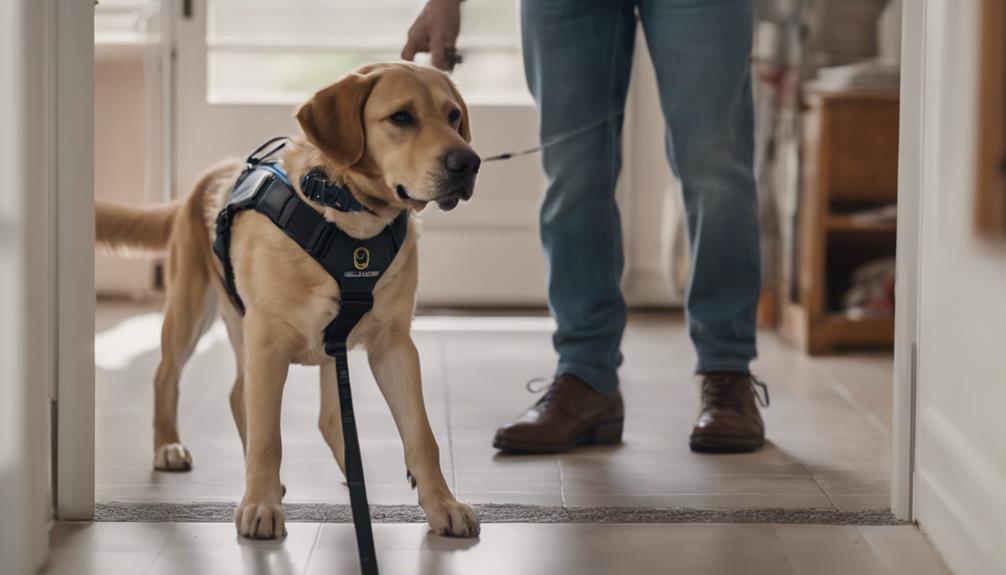
When training a service dog, focus on teaching your dog to perform specific tasks that help with your disability. Use clear and consistent commands or cues, so your dog responds accurately to your needs. This training enables your service dog to provide reliable support and assistance in daily activities.
Task-Specific Training
Task-specific training is essential for service dogs, as it enables them to perform tasks that directly benefit their handlers with disabilities. A service dog must be trained to perform identifiable tasks on command or cue to assist their human partner. This training involves teaching the dog to perform specific tasks tailored to the individual's needs and disability.
Examples of tasks include guiding the visually impaired, alerting to seizures, or providing mobility assistance. Service dogs can also be trained to provide emotional support and comfort to individuals with mental health disabilities, such as post-traumatic stress disorder (PTSD). The goal of task-specific training is to teach the dog to perform tasks reliably and consistently in various environments, ensuring public access.
Clear Command Cues
Clear command cues are essential for service dogs to perform tasks that assist individuals with disabilities. A service dog must learn to respond to distinct cues or commands that initiate specific tasks related to their handler's disability. Consistent cues ensure the dog takes the correct action to help their handler participate in daily life.
To achieve this, training should involve clear and consistent cues or commands that prompt the desired response. This helps the dog distinguish between tasks and provide tailored assistance. Positive reinforcement techniques, such as rewards and praise, encourage desired behaviors and strengthen the bond between the handler and service dog.
Using clear command cues guarantees accurate responses from your service dog, providing the necessary assistance to mitigate your disability. Effective cues rely on consistency, distinctness, and positive reinforcement. By focusing on these elements, you can ensure your service dog responds correctly and provides the support you need.
Trainer's Responsibilities and Certification
- Advertisement -
As a service dog trainer, you act as an ambassador for the industry. This means you must be knowledgeable about relevant laws, ensure the dog's health and grooming, and show respect for others. You're not only training a dog, but also representing the industry as a whole.
To fulfill your responsibilities, use humane training methods, monitor the dog's stress level, and provide regular breaks to prevent burnout. Always carry clean-up materials and arrange for prompt clean-up if the dog eliminates or gets sick in public.
To develop effective training plans, you need extensive knowledge of canine behavior, learning theory, and disability-specific needs. This includes selecting and breeding dogs with suitable temperaments and physical attributes, socializing them to various environments and stimuli, and educating handlers on service dog etiquette, laws, and rights.
Your role also involves providing ongoing support and training to ensure successful partnerships. Although certification is not required in the USA, many trainers choose to pursue certification in specialized areas to demonstrate their expertise and commitment to providing high-quality service dogs. Certification organizations, such as Assistance Dogs International (ADI) and the International Association of Assistance Dog Partners (IAADP), provide standards and accreditation for service dog trainers and organizations.
Public Access Testing and Evaluation
Public Access Testing and Evaluation
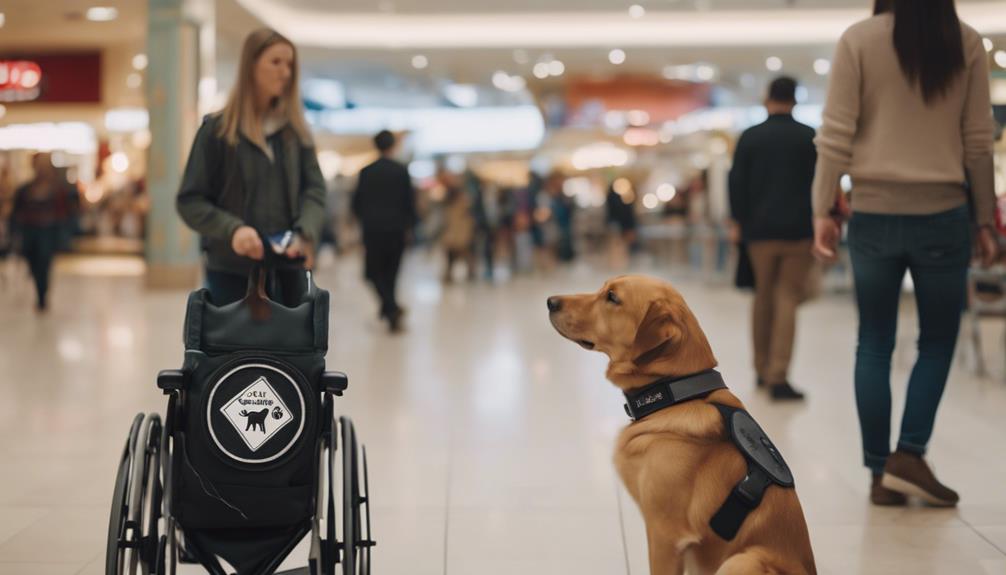
You and your service dog have invested considerable time in training and socialization. Now, it's time to undergo Public Access Testing and Evaluation, a crucial step in certifying your team's readiness for real-world settings. This evaluation assesses your team's performance in handling diversions and challenges in public places, not the disability-mitigating tasks or work.
To pass the Public Access Certification Test (PACT), your dog must have received at least 120 hours of training over six months, including 30 hours of outings to prepare them to work obediently and unobtrusively in public. The test consists of several modules:
- Leaving a motor vehicle
- Approaching buildings
- Building entry
- Traversing a building
- Recall from a distance
- Sit on command
- Downs on command
- Response to noise
- Restaurant manners
- Leash recovery
Examiners use a grading system to evaluate your team's performance. It's highly recommended to videotape the test to document your passing. During the evaluation, your service dog is tested on their obedience, manners, and ability to focus on you amidst various stimuli, including other animals, loud noises, and food. As a handler, you'll also be assessed on your ability to handle and command your service dog, as well as your understanding of their training and limitations.
Successful completion of public access testing and evaluation is critical for certifying a service dog team, as mandated by the Americans with Disabilities Act (ADA), and guarantees your access to public spaces and facilities.
Service Dog Laws and Access Rights
As a service dog owner, you have certain rights under the Americans with Disabilities Act (ADA). Your trained service dog is allowed to accompany you in public spaces, including restaurants, hotels, and public transportation, as long as they remain well-behaved and under your control.
Businesses cannot ask about your disability, but they can ask two questions: if the animal is a service dog and what tasks it has been trained to perform. You're not required to provide proof of certification or documentation. However, if your dog is disruptive or out of control, you may be asked to leave a public place.
It's essential to understand that emotional support animals, therapy dogs, and search and rescue dogs are not considered service dogs under the ADA and do not have the same access rights.
The ADA and the Fair Housing Act (FHA) protect individuals with disabilities who use service dogs from discrimination in housing and public accommodations. Service dogs are exempt from pet fees and deposits in housing, and landlords cannot refuse to rent to someone with a service dog.
Under the Air Carrier Access Act (ACAA), airlines must permit service dogs to accompany their handlers in the cabin of an aircraft. By knowing these laws, you can confidently navigate public spaces with your trained service dog, ensuring your needs are met.
Frequently Asked Questions
What Are the First Five Things That Need to Be Taught to Your Service Dog Candidate?
When training a service dog candidate, start with the basics. Teach "sit" and "stay" first. Socialization is next, exposing your dog to people, environments, and new experiences. Early exposure to sights, sounds, and smells is crucial. Then, introduce leash walking and simple commands. Finally, establish calmness and focus as core behaviors, laying the foundation for future training.
How Many Tasks Does a Dog Need to Know to Be a Service Dog?
The key to being a service dog is not about learning a certain number of tasks, but rather mastering specific skills that help mitigate a disability. Factors like breed, age, and training style don't determine the number of tasks a dog needs to know. What's important is that your dog can perform tasks consistently in various public settings, regardless of certification requirements.
Focus on training your dog to perform tasks that address your unique needs. This will help you achieve the assistance you need. Remember, it's not about the quantity of tasks, but the quality of their execution.
How Many Commands Must a Dog Learn to Be a Service Dog?
A service dog needs to learn a combination of basic obedience commands and task-specific skills tailored to its handler's needs. The exact number of commands is less important than the dog's ability to consistently respond to them in different environments.
Basic obedience commands like Sit, Stay, and Heel provide a foundation for more advanced training. The dog must also learn specific skills to assist its handler, such as opening doors or detecting medical conditions.
Factors like task complexity, breed limitations, and learning pace influence the number of commands a service dog can learn. For example, a dog trained to assist a person with mobility issues may need to learn more complex tasks than one trained for emotional support.
Ultimately, a service dog's effectiveness is measured by its ability to generalize its skills to new situations and retain them over time. A well-trained service dog can learn to respond to 20-50 commands or more, but the quality of its training is more important than the quantity of commands.
What Are the Three Keys to Dog Training?
To successfully train a dog, you need to focus on three key elements: Positive Reinforcement, Clear Communication, and Consistent Routine. Positive Reinforcement involves using Reward Systems to encourage your dog to perform desired behaviors. Clear Communication is about conveying what you want your dog to do through consistent commands and body language. A Consistent Routine helps your dog understand what is expected of them and builds trust. By combining these elements, you can achieve Basic Obedience and Socialization Skills, which are essential for developing your dog's Emotional Intelligence and Canine Learning. With the right Training Methods, you can unlock your dog's full potential and build a strong bond.
In summary
Before bringing a service dog into your life, understand that their training is crucial but not the only requirement. Public outings will test their focus amidst distractions and your ability to handle challenging situations. A rigorous training and evaluation process is essential for certification, but it's not the end of the journey. Ongoing training and socialization are necessary to maintain your dog's skills.
To ensure success, consider the following key requirements:
- Socialization: Expose your dog to various environments, people, and situations to help them stay calm and focused.
- Ongoing Training: Regularly practice and reinforce learned behaviors to prevent skill regression.
- Handling Distractions: Teach your dog to ignore distractions and maintain their attention on you.
- Building Confidence: Gradually increase the difficulty of training scenarios to boost your dog's confidence in their abilities.
Remember, owning a service dog requires a commitment to continuous training and socialization.
- Advertisement -